5 Robots Already Working Among Us (And You Didn’t Even Notice)
When we think about robots, it’s easy to imagine futuristic humanoids walking among us or sci-fi scenarios where machines take over entire industries. But the reality is far more subtle — and much closer than most people realize.
Robots are no longer confined to laboratories or high-tech factories. They are already embedded in our daily lives, quietly performing tasks that make businesses more efficient and services faster. The most surprising part? Many of them operate so seamlessly that we don’t even notice them.
Here are five types of robots that are already working among us — often hidden in plain sight.
1. Warehouse Robots (The Invisible Workforce Behind Your Deliveries)
Every time you receive a package quickly — sometimes within hours — there’s a high chance a robot played a role in making that happen.
Companies like Amazon, Alibaba, and Ocado rely heavily on autonomous mobile robots (AMRs) inside their warehouses. These robots move shelves, transport goods, and optimize storage without human intervention. Instead of workers walking long distances to find items, robots bring the products directly to them.
What makes these robots so effective is their coordination. Hundreds (sometimes thousands) of units operate simultaneously, guided by algorithms that calculate the fastest routes and avoid collisions in real time.
From the outside, you just see a fast delivery. Behind the scenes, it’s a highly synchronized robotic ecosystem working non-stop.
2. Cleaning Robots in Public Spaces
Robot vacuums in homes are already common, but cleaning robots in public spaces are even more widespread — and much less noticeable.
Airports, shopping malls, hospitals, and office buildings increasingly use autonomous cleaning robots to maintain hygiene standards. These machines can vacuum, scrub floors, and even disinfect surfaces using UV light.
Unlike traditional cleaning crews, these robots can operate during off-hours or quietly navigate around people during the day. They use sensors and mapping technology to move efficiently through complex environments.
Next time you walk through a spotless airport terminal late at night or early in the morning, there’s a good chance a robot helped clean it — without drawing any attention.
3. Delivery Robots and Sidewalk Bots
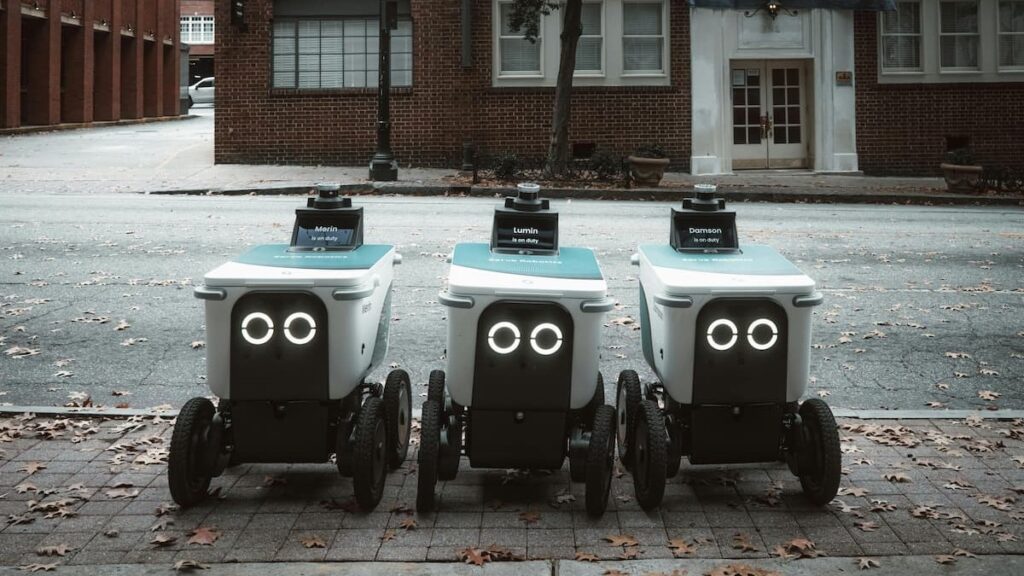
In some cities, small robots are already delivering food, groceries, and parcels directly to people’s doors.
These delivery robots — often about the size of a cooler — navigate sidewalks using cameras, GPS, and AI. Companies like Starship Technologies and Nuro have deployed fleets of these robots in urban areas and university campuses.
They might look unusual at first glance, but many people simply walk past them without a second thought. That’s because they blend into the environment surprisingly well.
These robots are especially useful for short-distance deliveries, reducing costs and improving efficiency for businesses. They also represent a step toward more automated last-mile logistics — one of the most complex parts of the supply chain.
4. Customer Service Robots
Robots are also entering customer-facing roles, particularly in environments where efficiency and consistency are key.
You can already find robots in hotels, airports, and retail stores acting as receptionists, guides, or assistants. Some greet customers, provide directions, or even deliver items to rooms.
For example, certain hotels use robots to bring towels or room service to guests. In airports, robots can help passengers find gates or answer frequently asked questions.
While they may not fully replace human interaction, they are excellent at handling repetitive tasks. This allows human staff to focus on more complex or personalized service.
In many cases, people interact with these robots without realizing how advanced the underlying technology actually is.
5. Surgical Robots in Hospitals
One of the most impactful — and least visible — uses of robotics is in healthcare.
Surgical robots, such as the well-known da Vinci system, assist doctors in performing highly precise procedures. These robots do not operate independently but act as extensions of the surgeon’s hands, enabling greater control, smaller incisions, and improved outcomes.
Patients often don’t realize that a robot played a role in their surgery. From their perspective, the experience is simply faster recovery and reduced complications.
Beyond surgery, robots are also used for tasks like medication delivery within hospitals, patient monitoring, and even rehabilitation.
This is a powerful reminder that robots aren’t just about efficiency — they can directly improve quality of life.
Why You Don’t Notice Them
One of the most interesting aspects of modern robotics is that the more successful a robot is, the less visible it becomes.
Unlike the dramatic portrayals in movies, real-world robots are designed to integrate smoothly into existing systems. They don’t need to look human or draw attention — they just need to work.
Several factors contribute to this “invisibility”:
- Specialization: Most robots are built for specific tasks, not general interaction
- Design: Many are intentionally simple or discreet
- Environment integration: They operate within structured systems like warehouses or hospitals
- User experience: The goal is seamless service, not novelty
As a result, we interact with the outcomes of robotics far more often than we interact with the robots themselves.
The Bigger Picture: We’re Already Living in the Future
The idea that robots are “coming soon” is outdated. They’re already here — just not in the form we expected.
Instead of humanoid assistants walking beside us, we have highly specialized machines working behind the scenes, optimizing industries, reducing costs, and improving efficiency.
And this is only the beginning.
As artificial intelligence continues to evolve, robots will become more adaptable, more autonomous, and more present in everyday environments. The line between digital intelligence and physical machines will continue to blur.
Final Thoughts
Robots are no longer a distant concept or a futuristic dream. They are already part of our daily lives, quietly shaping how goods are delivered, spaces are cleaned, services are provided, and even how surgeries are performed.
The real question isn’t whether robots will become part of our world — it’s how much more integrated they will become in the years ahead.
And chances are, when that happens, you might not even notice.